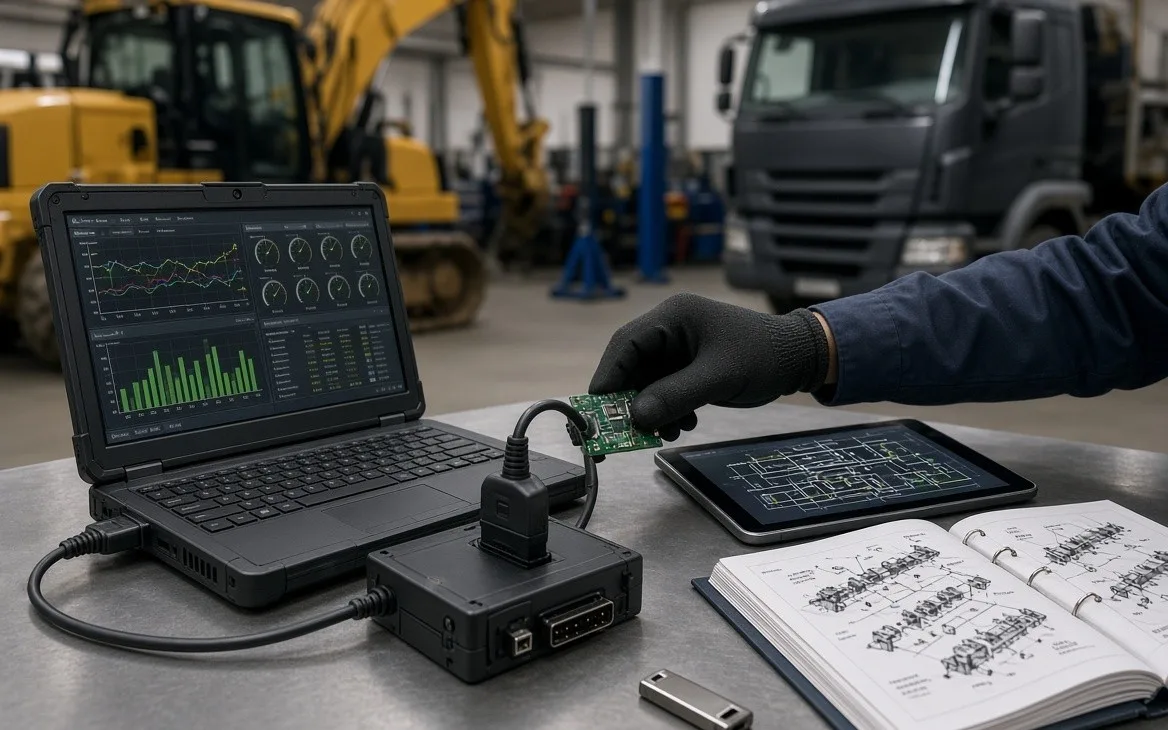
Anyone who spends time around heavy equipment knows the frustration of a machine that won’t run right after a repair. You swap an ECM, update software, or chase a stubborn fault code, and suddenly the whole job slows down. Having the correct OEM repair manuals, factory flash files, and calibration procedures on hand is what separates a smooth return to service from a long afternoon of guessing.
OEM Manual Store focuses on exactly that need. The site offers instant digital downloads of factory service manuals, workshop manuals, wiring diagrams, parts catalogs, and programming files for Caterpillar, John Deere, Daimler Truck, CASE, Komatsu, and many other brands. These are the same resources dealer technicians use every day.
Caterpillar Programming Files and Why the Right Version Counts
Caterpillar machines rely on Electronic Control Modules that need the correct software loaded through Cat Electronic Technician (Cat ET). The 2020 factory flash file collection, for example, contains original FL2, FLS, CFG, and CNF files used for ECM programming. These files control fueling, emissions strategy, horsepower ratings, and how the machine responds to operator inputs.
Matching the file to the specific engine serial number, ECM part number, application, and emissions level is critical. A mismatched file can leave you with derates, permanent codes, or an ECM that needs dealer-level recovery. Technicians who work regularly on excavators, dozers, wheel loaders, and industrial engines keep current programming collections available for this reason. The 2020 set remains useful for many machines still running that software generation, while later updates cover newer units.
Before starting a flash, most experienced techs check battery voltage, keep a charger connected, and confirm the communication adapter and cables are solid. Low voltage remains one of the most common reasons a flash fails. Once the new software is loaded, Cat ET often flags required calibrations—timing, injector trim, throttle position, transmission fill, or implement solenoid calibrations. Skipping those steps or ignoring the on-screen conditions usually creates more codes than it solves.
Practical Calibration Habits That Save Time
After any major software change or component replacement, calibrations are not optional. Engine timing calibration on many Cat engines requires a transducer in the flywheel housing, a warm engine, and a steady rpm. Injector trim codes must be entered in the correct cylinder order. Machine-side calibrations for blades, rippers, payload systems, or grade control each have their own conditions that Cat ET enforces.
The safest approach is methodical: save the original configuration before changing anything, meet every condition the software lists, clear codes after each successful calibration, and verify live data before releasing the machine. When a calibration keeps failing, the problem is often wiring, a related active code, or a mechanical issue rather than the procedure itself. Official Testing and Adjusting information from the correct service manual for that serial number range is the reference that actually matches the machine in front of you.
Beyond Caterpillar: John Deere, Daimler, and Broader Coverage
The same principle applies across brands. John Deere PLD files and related programming collections help technicians update controllers on agricultural and construction equipment. Daimler Truck service and repair manuals cover the heavy-duty truck platforms that keep freight moving. Having factory documentation for the exact model and year prevents the costly trial-and-error that comes from generic aftermarket information.
OEM Manual Store organizes these resources by brand so users can find Caterpillar flash files, John Deere programming packages, Daimler Truck manuals, and workshop information for CASE, JCB, Volvo, and others without hunting through scattered sources. Digital delivery means the files are available immediately after purchase—useful when a machine is down and the shop needs the information the same day.
Keeping Work Productive Instead of Frustrating
Equipment downtime is expensive. A technician who can pull the correct factory flash file, follow the matching calibration sequence, and reference the official service procedures finishes the job faster and with fewer comebacks. Owners and fleet managers benefit too: machines that leave the shop with accurate fueling, proper emissions control, and responsive hydraulics stay productive longer.
The practical reality is that official software and manuals remain the most reliable path. Third-party collections exist, but verifying the exact file against the ECM and serial number, maintaining stable power during programming, and completing every required calibration are the habits that keep problems from compounding.
Whether the next job involves a Caterpillar excavator that needs a 2020-era programming update, a John Deere machine requiring PLD files, or a Daimler truck that needs detailed service information, having the factory resources ready makes the difference. The goal is simple—get the machine back to work correctly the first time.