People search for this question for two reasons. Some are shopping for a used machine and see a D110 listed next to an E120 for roughly the same money. Others already own one and want the right service manual for a repair. Both need the same thing first: knowing which “D” and which “E” you’re dealing with, because John Deere uses those letters in more than one product line, and they don’t mean the same thing everywhere.
This guide covers the two lines people most often compare: the 100 Series lawn tractors (D100 vs E100) and the 5 Series utility tractors (5D vs 5E). At the end, there’s a section on finding the correct operator’s manual, technical manual or parts catalog for your exact model.
First, the Letters Don’t Mean One Thing
On John Deere lawn tractors, the letter mostly tells you the generation. On the 5 Series utility tractors, the letter tells you the trim level. If you mix those up, you’ll end up comparing the wrong machines, or ordering the wrong manual.
Lawn Tractors: D100 and E100 Are Two Generations of the Same Family
The entry-level 100 Series lawn tractors have gone through several name changes over the years. Owners on equipment forums usually describe the timeline like this: the D series ran from 2011 to 2017, the E series from 2018 to 2020, and the S series from 2021 onward. So a D105 and an E100 are not competing products. One replaced the other.
What the D100 Series Brought In
When Deere launched the D100 line, the selling points were fuel economy and comfort. The new lineup had eight models, all with engines built exclusively for John Deere, a fuel tank designed to cut emissions, and a reworked hood and seat area for better visibility. Every model shipped with the Edge Cutting System.
The base D100 is where you’ll see the biggest mechanical difference from later machines. The D100 used a 17.5 hp engine with a 5-speed transmission, while the D110 stepped up to a 19.5 hp engine with an automatic transmission and two-pedal forward and reverse. If you have a D100 or D105, check which transmission yours has before you buy belts or look up adjustment procedures. Gear-drive and automatic models don’t share every part.
What Changed With the E100 Series
The E100 kept the same basic idea: a simple, affordable mower for a typical suburban yard. The changes were mostly about usability. Deere’s own spec sheet for the E100 lists a 17.5 hp engine, a deep deck design that lifts grass for a cleaner cut, an improved deck lift lever, a wider operator station and a stronger battery for starting after long storage.
On the drivetrain, the E100 uses an automatic CVT transaxle with foot control and a 42-inch Edge mower deck. That’s the practical difference most owners notice: no hand shift lever, just pedals.
Warranty didn’t move much between the two generations. The E100 carries a 2 year / 120 hour bumper-to-bumper warranty, and dealers comparing the older line to the X300 noted the same 2 year / 120 hour coverage on D100 Series mowers.
So Is an E Series Lawn Tractor Better Than a D Series?
Not in a dramatic way. Both are entry-level machines. The E100 is a refinement: easier deck adjustment, foot-pedal drive across the line, small comfort updates. A well-kept D110 with good service history can be a better buy than a neglected E120.
What matters more when buying used:
- Hours on the engine and how often the oil was changed
- Condition of the deck spindles and drive belt
- Whether the transaxle has been worked hard on hills or used for heavy towing
- Whether the seller has the original Jonh Deere operator’s manual
That last point tells you a lot about how the machine was looked after.
Utility Tractors: 5D vs 5E Is a Trim Level Difference
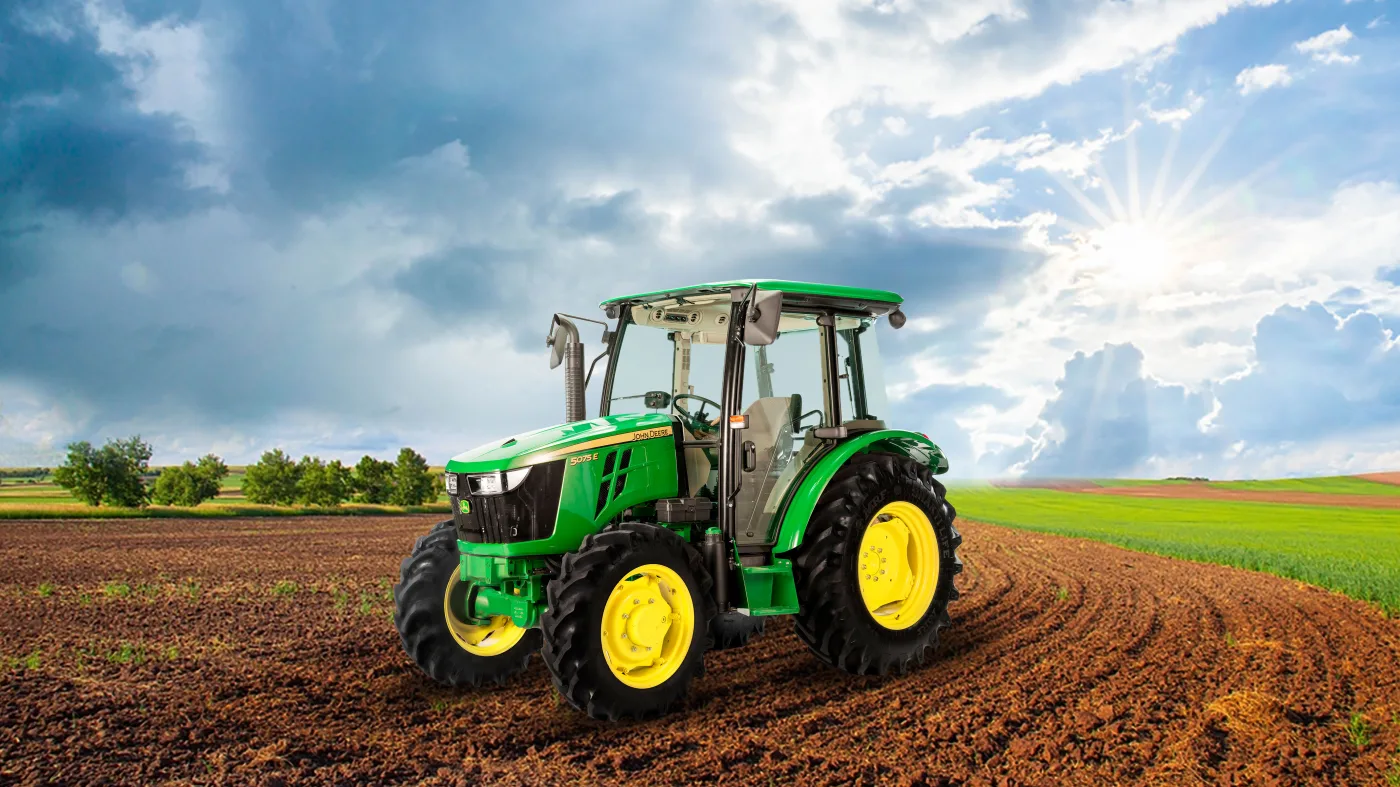
This is where the comparison gets more meaningful for farmers and property owners. The 5D and 5E were sold side by side, not one after the other.
When Deere introduced the lineup, it described both as “low on the frills and price,” with horsepower from 45 to 75. The key split was the front axle. The 5D came only in 2WD, while the 5E was offered in either 2WD or mechanical front-wheel drive (MFWD).
Smaller Differences That Matter in Daily Use
Owners comparing the two in detail point out the brakes as one of the less obvious changes: the D series uses mechanical wet disc brakes, while the E series uses hydraulic wet disc brakes. Forum users also mention more tractor weight on comparable E models, which helps with loader work and pulling.
If you’re working small fields, hauling, or running a rotary cutter on flat ground, a 5D does the job at a lower cost. If you plan to use a front loader regularly, work on slopes, or deal with wet ground, the 5E’s MFWD option and extra weight make a real difference.
A Note for Buyers in India
In the Indian market, the 5D and 5E names are still active and very common. The 5D series is generally known for value and versatility, while the E series is pitched toward heavy-duty work and operator comfort. Some E series models also include JDLink for remote tracking. The engines and specs differ by region, so a 5050D sold in India and a 5D sold in the US years ago should not be treated as the same tractor when ordering parts or manuals.

Finding the Right Manual for Your D or E Series Machine
This is where many owners lose time and money. Because the names look so similar, it’s easy to buy a manual for the wrong machine.
Know Which Kind of Manual You Need
John Deere publishes several types of documents, and they serve different purposes:
- Operator’s manual – daily use, safety, maintenance intervals, basic adjustments. Good for owners doing oil changes and blade work.
- Technical manual (service manual) – the shop-level book. Disassembly, torque specs, electrical diagrams, troubleshooting. This is what you need for transaxle, engine or wiring repairs.
- Parts catalog – exploded views and part numbers. Essential when ordering replacement parts.
Check the Serial Number, Not Just the Model Name
Even within one model, John Deere revises manuals over time. The E100 alone had separate operator’s manuals listed by year, including OMUC17903 from 2017, OMUC20527 from 2018 and OMUC23650 from 2019. Specifications and procedures can change between those versions.
On the E100, the serial number plate is on the left side under the fender near the rear wheel. On utility tractors, look on the frame or near the front axle. Write the full number down before you search for a manual or call a parts counter. It’ll save you a return.
Before You Buy a Manual, Confirm Three Things
- The exact model (D110, not just “D100 series”)
- The serial number range the manual covers
- Whether it’s an operator’s manual, technical/service manual or parts catalog
If all three match your machine, you’ll have the right torque values, wiring colors and part numbers in front of you, which is the difference between a two-hour repair and a weekend of guessing.